 |
| Alter do Chão, Brazil - The Beach Richard N Horne, CC BY-SA 4.0, via Wikimedia Commons |
The sun rises over Rio de Janeiro, spilling gold across the curve of Copacabana Beach.
A couple from Mumbai, or London, or New York, stands barefoot in the sand, the Atlantic breeze lifting the scent of salt and music.
Nearby, a street vendor drums softly while preparing fresh coconut water. No brochure explains this moment; it is felt. This is Brazil as tourists experience it—not read about, but lived. And increasingly, Indian travelers are choosing to live it more than ever before.
Brazil’s tourist appeal does not rely on a single landmark or season. It unfolds like a long, vibrant story told through rainforests, festivals, flavors, and faces. For Indian tourists, the country feels both astonishingly different and surprisingly familiar, creating a connection that goes deeper than sightseeing.
A Land That Feels Alive
Brazil does not wait to be discovered quietly. It announces itself through color, rhythm, and scale. The Amazon breathes with mist and birdsong, rivers stretching like silver veins through endless green. Iguazu Falls crashes with a roar that shakes the ground beneath visitors’ feet, leaving them soaked and smiling. In Salvador, colonial streets glow in pastel hues while drums echo late into the night.
For Indian tourists accustomed to sensory richness—crowded bazaars, temple bells, layered cuisines—Brazil feels intuitively understandable. It is large, loud, emotional, and unapologetically alive. Silence exists here too, deep in the rainforest or along untouched beaches, but even that silence feels charged with presence.
This sense of vitality is one of Brazil’s strongest attractions. Travelers are not passive observers. They dance during Carnival, taste feijoada at family-run restaurants, and join locals cheering at football matches where emotion flows as freely as conversation.
Cultural Resonance Beyond Distance
At first glance, India and Brazil appear worlds apart, separated by oceans and languages. Yet Indian tourists often describe an unexpected sense of comfort. Families sit together late into the evening, meals are social rituals, and warmth toward guests feels instinctive rather than performed.
Brazilian hospitality mirrors Indian values. Smiles come easily. Conversations start without formality. Strangers become guides, storytellers, and sometimes friends. For Indian tourists, who often travel in groups or with extended family, this openness makes exploration feel safe and welcoming.
Religion and spirituality, though expressed differently, also create subtle connections. From Afro-Brazilian traditions in Bahia to grand cathedrals standing alongside everyday faith practices, Brazil reflects a layered spiritual landscape that Indian travelers recognize instinctively.
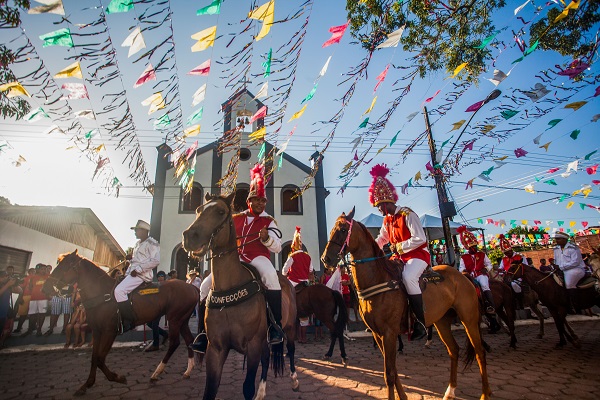
Festival in Mazagão, Amapá, Brazil
Government of Amapá, CC BY 3.0, via Wikimedia Commons
A Festival That Never Ends
Government of Amapá, CC BY 3.0, via Wikimedia Commons
Carnival may be Brazil’s most famous export, but the country celebrates life year-round.
Music spills into streets, dance appears in unexpected places, and festivals erupt with little warning.
Indian and Western tourists, familiar with celebrations that blend devotion, color, and community, are drawn naturally to this rhythm.
During Carnival, Indian visitors do not merely watch parades; they feel the ground vibrate beneath samba dancers, the air thick with glitter and laughter. It recalls the emotional immersion of Holi or Durga Puja—festivals where boundaries dissolve and participation matters more than observation.
Beyond Carnival, regional celebrations reveal Brazil’s diversity. Each state feels like a different chapter, offering Indian tourists the joy of discovering many countries within one.
Nature That Redefines Scale
Indian travelers often speak of Brazil’s landscapes with awe. The sheer scale feels humbling. The Amazon rainforest is not just seen; it surrounds, absorbs, and silences. Wildlife appears suddenly—a flash of feathers, a ripple in dark water. Eco-lodges offer mornings filled with birdcalls instead of alarms.
For Indian tourists increasingly interested in sustainable travel, Brazil’s biodiversity offers both adventure and reflection. Guided jungle walks, river cruises, and conservation experiences allow visitors to engage with nature responsibly rather than consume it.
Brazil’s beaches add another layer. From famous shores like Ipanema to secluded coastal stretches, the ocean becomes a daily companion. Indian travelers, many from landlocked cities, find freedom in long coastal drives and open horizons.

Olympics football—Brazil v. Egypt
lhourahane, CC BY 2.0, via Wikimedia Commons
Football, Fame, and Familiar Passion
lhourahane, CC BY 2.0, via Wikimedia Commons
When an Indian tourist enters a Brazilian football stadium, language becomes unnecessary.
Cheers rise in unison, hands fly into the air, and strangers hug at the sound of a goal.
The passion for football in Brazil resonates deeply with Indian fans who understand sport as emotion, identity, and escape.
Tours of legendary stadiums, murals of football icons, and local matches all contribute to a sense of shared enthusiasm. This shared passion helps Indian tourists feel less like outsiders and more like participants in a global celebration.
Practical Reasons Strengthen Emotional Appeal
Beyond emotional connection, practical factors also influence why Indian tourists visit Brazil in growing numbers. Improved air connectivity, simplified visa processes, and increased tourism promotion have made the journey more accessible.
Brazil’s growing interest in Indian culture, business, and education has also encouraged travel. Indian professionals attend conferences, students explore academic opportunities, and families combine business trips with leisure travel. Over time, these visits evolve into deeper tourism interest.
Brazil’s affordability compared to other long-haul destinations further enhances its appeal. Indian tourists find value in accommodations, food, and local transport without sacrificing experience quality.

Cuisine of Brazil—Campinas, SP, Brazil.
Daderot, Public domain, via Wikimedia Commons
Food as a Bridge Between Cultures
Daderot, Public domain, via Wikimedia Commons
At a small restaurant in São Paulo, an Indian family tastes pão de queijo for the first time.
Warm, soft, comforting—it needs no translation. Brazilian cuisine, rich in spices, textures, and slow-cooked traditions, speaks to Indian palates.
Vegetarian options are increasingly available, easing concerns for Indian travelers. Fresh fruits, tropical juices, and street snacks add daily joy to exploration. Food becomes not just nourishment but discovery, conversation, and memory.
A Journey That Stays With You
When Indian tourists leave Brazil, they carry more than photographs. They carry rhythms tapped unconsciously on airplane armrests, flavors remembered during quiet meals back home, and stories told with animated hands. Brazil does not fade quickly. It lingers.
The interest in Brazil as a tourist destination continues to grow because it offers something rare: difference without distance, excitement without alienation. For Indian tourists, Brazil feels like a parallel universe—one where life is lived loudly, lovingly, and fully.
In the end, Brazil does not ask tourists to understand it completely. It asks them to feel it. And for Indian travelers, that feeling is irresistible.


Comments are welcome.
ReplyDelete