_female_3.jpg) |
| Bengal tiger (Panthera tigris tigris) female, Kanha National Park, India. Charles J. Sharp, CC BY-SA 4.0, via Wikimedia Commons |
Introduction
Before dawn, a jeep idles outside a forest gate. The air smells of dust, teak leaves, and woodsmoke from nearby homes.
A naturalist checks permits while a tea seller pours steaming chai into small glasses. Somewhere beyond the sal trees, a tiger moves unseen.
In India, tiger tourism begins not inside the forest, but at its edges—where lodges wake early, kitchens start cooking, and villages prepare for another day shaped by the presence of the wild.
Rather than existing as a distant spectacle, tiger tourism in India is woven into lived landscapes. From Ranthambore to Kaziranga, Bandhavgarh to Nagarhole, the experience of seeing a tiger is inseparable from where travelers sleep and what they eat. Accommodation and local food do not merely support tourism; they narrate it, offering visitors a grounded encounter with place, people, and ecology.
 |
| Harsh.kabra.98, CC BY-SA 4.0, via Wikimedia Commons The picture was shot on Zone 3 of the Ranthambore Tiger Reserve. |
Forest Edges and Places to Stay
Across India’s major tiger reserves, accommodation spreads outward from the forest boundary like a quiet buffer.
do not rise inside the core zones; they cluster along approach roads, riverbanks, and village edges. At dawn, their verandas face mist rather than monuments.
In places like Bandhavgarh and Kanha in Madhya Pradesh, low-rise lodges blend into the sal forest palette. Stone pathways lead to cottages cooled by thick walls and shaded roofs. At night, power is often minimal. The hum of generators fades early, replaced by cicadas and the distant alarm calls of deer. Luxury here is measured less by spectacle and more by proximity—how close one sleeps to the forest line.
Ranthambore, set against dry scrub and ancient ruins, offers a different texture. Old havelis converted into heritage hotels sit beside newer eco-resorts. Rooms open onto courtyards where peacocks wander freely. The accommodation reflects the landscape: austere, sunlit, shaped by history rather than concealment.
In the northeast, near Kaziranga National Park, raised cottages sit on stilts to survive monsoon floods. Bamboo walls, thatched roofs, and wide windows allow air and sound to pass through. Guests fall asleep to rain on leaves and wake to grasslands glowing pale gold. The structures feel temporary, as though they might quietly retreat if the river rises.
The Rhythm of Lodge Life
Accommodation near tiger reserves follows the rhythm of the forest, not the clock. Mornings begin before sunrise. Staff knock gently, offering tea. Breakfast waits until after the safari. Afternoons stretch long and quiet, shaped by heat and the need for wildlife to rest as much as humans.
Many lodges employ people from nearby villages as guides, cooks, cleaners, and drivers. Conversations drift easily—from tiger sightings to crop cycles, from rainfall to forest rules. The stay becomes a shared pause between safaris, where tourism and everyday life overlap without fully merging.
Even in higher-end properties, there is restraint. Pools sit low, lights remain soft, and music fades early. The accommodation shows a form of tourism that bends itself around conservation boundaries, acknowledging that the forest is not a backdrop but a neighbor.
Eating Close to the Forest
Food near tiger reserves is shaped by geography, season, and tradition. Menus change with availability. Vegetables arrive from nearby farms or local markets. Rice, lentils, and flatbreads form the backbone of most meals, carrying flavors specific to each region.
In central India, meals near Kanha or Pench often arrive with the warmth of home cooking. Dal simmers slowly. Baingan bharta carries the smoky trace of open fires. Freshly made rotis puff and collapse in quick succession. The food is filling rather than ornamental, designed for early mornings and long waits.
Ranthambore’s kitchens draw from Rajasthani traditions. Ker sangri, gatte ki sabzi, and millet rotis appear beside simpler curries adapted for travelers. Spices are assertive but balanced, offering heat without overwhelming those unfamiliar with desert flavors.
Near Kaziranga, plates reflect the northeast’s lighter touch. Steamed rice anchors meals alongside lentils, seasonal greens, and fish cooked with mustard or herbs. Fermented flavors appear subtly, never explained, simply served. Meals feel closely tied to the floodplains and rivers that define the region.
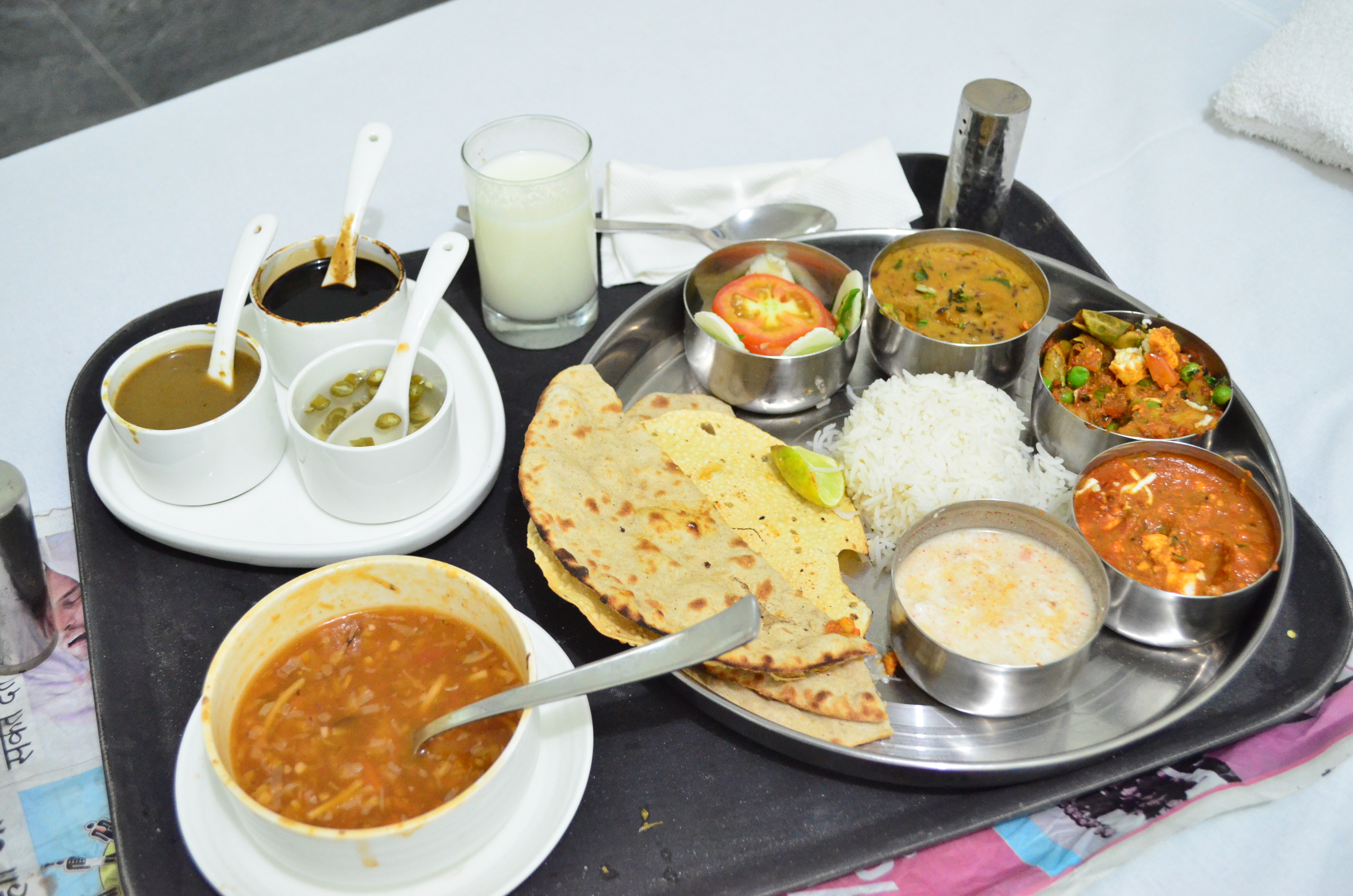 |
| Typical Veg North Indian Thali Prav2991993, CC BY-SA 4.0, via Wikimedia Commons |
Dining as Experience, Not Display
Meals are often taken communally, at long tables or open decks. There is no rush. Safari stories surface between bites. Naturalists sketch pugmarks on napkins.
Staff explain ingredients when asked, not as a performance but as familiarity.
Some lodges serve food outdoors, under lanterns or trees. The clink of cutlery competes with night insects. In these moments, dining becomes part of the landscape. The boundary between tourist and terrain softens.
 |
Pranavanish, CC BY-SA 4.0, via Wikimedia Commons |
Even where international dishes appear—pasta, pancakes, grilled vegetables—they are adapted to local kitchens and rhythms.
The food does not attempt to distract from the forest. It accompanies it.
Local Economies and Shared Spaces
Tiger tourism sustains more than wildlife protection. It shapes local economies through employment, produce sourcing, and small-scale entrepreneurship. Vegetable vendors, milk suppliers, spice sellers, and transport workers all feed into the ecosystem of accommodation and food.
Homestays have emerged near several reserves, offering simpler rooms and meals cooked in family kitchens. Guests eat what the household eats. Breakfast might be poha or rice porridge. Dinner might be seasonal vegetables and pickles stored from the last harvest. These stays narrate tiger tourism at a human scale, where conservation and livelihood intersect daily.
Sustainability Without Slogans
Many accommodations near tiger reserves operate with visible restraint. Water is reused. Waste is sorted quietly. Plastic is minimized. These practices are rarely announced loudly. They are folded into routine.
Food waste is limited by fixed meal timings and set menus. Portions are generous but thoughtful. Kitchens adjust based on guest numbers rather than abundance. Sustainability appears here not as branding but as a habit, shaped by proximity to protected landscapes.
 |
| Prabukumar84, CC BY-SA 4.0, via Wikimedia Commons Bandhavgarh National Park |
Conclusion
Tiger tourism in India unfolds through early mornings, shaded rooms, and meals that carry the taste of place.
Accommodation near tiger reserves does not compete with the forest; it leans toward it.
Local food does not perform authenticity; it sustains bodies moving in and out of wild spaces.
By staying close to the forest edge and eating from regional kitchens, travelers encounter tigers not as isolated icons but as part of living landscapes supported by people, routines, and restraint. In this way, tiger tourism in India is narrated not only through sightings, but through where one sleeps, what one eats, and how quietly one learns to wait.

_female_3.jpg)


Comments are heartily welcome.
ReplyDelete